
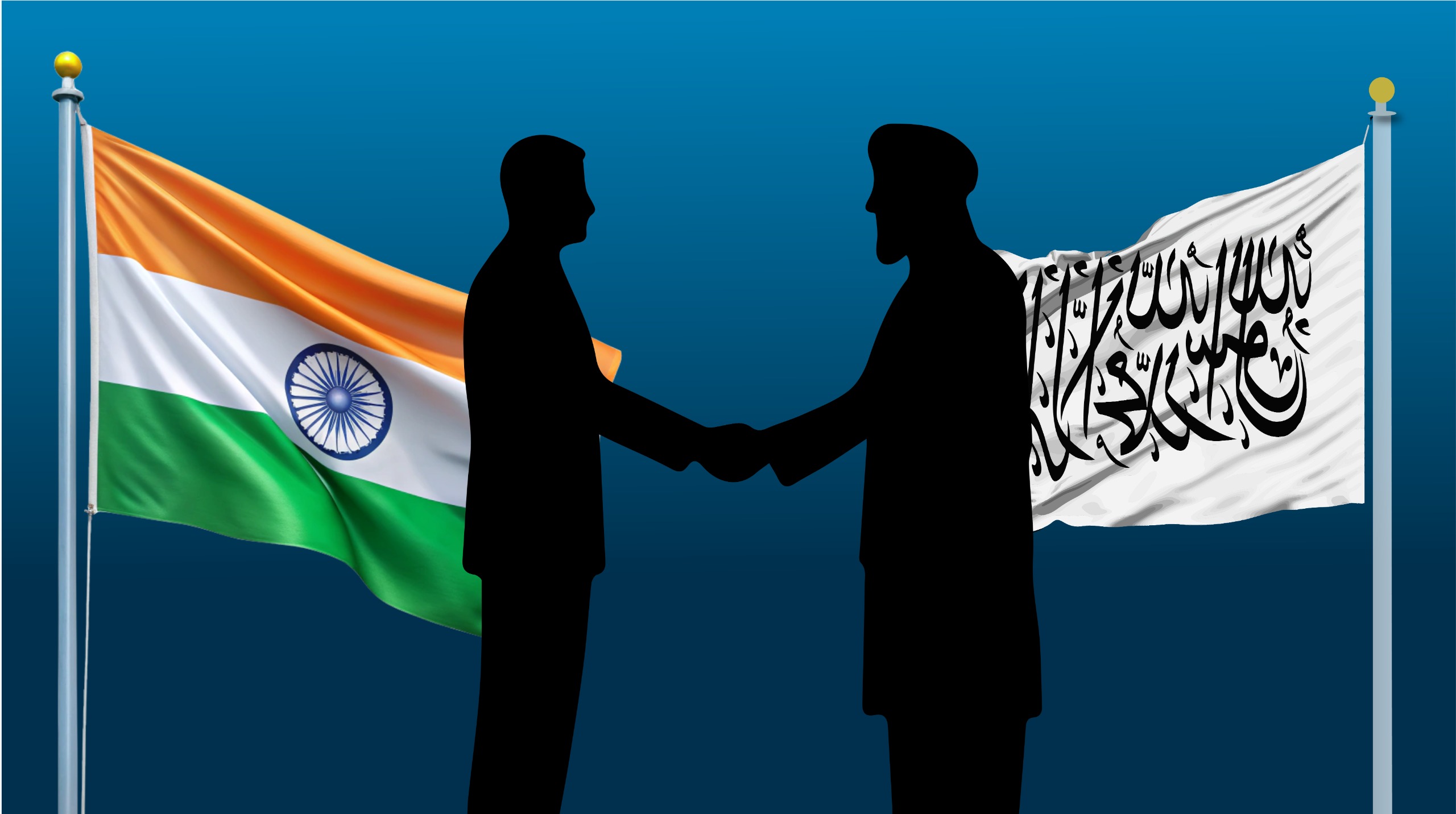
The emerging diplomatic exchanges between India and the Taliban-led Afghanistan mark one of the most consequential and pragmatic shifts in South-Asian geopolitics. The deployment of an Indian technical team in Kabul and the restoration of a limited diplomatic presence signal the end of India’s two-decade-long reliance on the Afghan Republic and the beginning of a complex era of realpolitik. This move from principled disengagement to cautious re-engagement is not a mere policy tweak but a strategic adaptation to the new regional reality. Understanding this recalibration requires examining India’s historical investments in Afghanistan, its immediate security concerns, and the broader regional implications of this engagement.
India’s ties with Afghanistan are grounded in deep civilizational and cultural continuity. Parts of present-day Afghanistan were incorporated into the Mauryan Empire in the 4th century BCE, with Ashoka later reinforcing these ties through the spread of Buddhism and construction of monastic sites. As time progressed, the medieval period saw a shift from shared cultural growth to political and military interactions. With figures like Mahmud of Ghazni and Muhammad Ghori invading India, Afghan dynasties like the Lodis ruling Delhi, and Babur marching from Kabul to establish the Mughal Empire in India; making Afghanistan a decisive geopolitical springboard in shaping medieval India. During the British colonial era, Afghanistan became a strategic buffer in the “Great Game” between Britain and Russia, leading to three Anglo-Afghan wars.
Following India’s independence in 1947, relations with Afghanistan were cooperative, and mutually respectful partnership marked by trust, cultural affinity, and shared strategic interests. India supported Afghanistan’s decision to remain non-aligned during the Cold War, and cultural exchanges flourished. Afghan students studied in Indian universities, Indian films and music became popular in Afghan cities, and traditional trade continued. Figures like Khan Abdul Ghaffar Khan, also known as the “Frontier Gandhi,” embodied the shared history of peace and resistance, maintaining strong emotional ties between the Pashtun community and India. However, the Soviet invasion of Afghanistan in 1979 shifted the regional landscape dramatically. India, adhering to its strategic calculations and desire to counter Pakistan’s growing influence, supported the Soviet-backed Afghan government. Meanwhile, Pakistan and the United States backed the Mujahideen resistance. India continued humanitarian assistance and maintained its diplomatic presence in Kabul throughout the conflict.
The end of Soviet influence and the subsequent Afghan civil war created a vacuum that led to the rise of the Taliban in the mid-1990s. With the strong support from Pakistan’s intelligence establishment, the Taliban captured Kabul in 1996, marking a turning point in India–Afghanistan relations. India refused to recognize the Taliban regime, shut down its embassy, and instead lent political and limited logistical support to the anti-Taliban Northern Alliance. Taliban was viewed as a Pakistan-backed threat to Indian interests. The relationship deteriorated further after the 1999 hijacking of Indian Airlines flight IC-814, which was taken to Kandahar, that was under Taliban control at the time. India was compelled to release several terrorists, including Masood Azhar, who went on to establish the militant group Jaish-e-Mohammed. The Taliban’s ideological leanings and repressive rule, its history of sheltering extremist groups and creating conditions that enabled Al-Qaeda’s rise, along with its support for anti-India militants and close alignment with Pakistan’s security establishment, made Afghanistan a significant and persistent security concern for India.
Following the collapse of the Taliban regime in 2001, in the aftermath of the 9/11 attacks and the initiation of the U.S.-led Operation Enduring Freedom, India intentionally chose not to engage militarily. It instead emerged as a key reconstruction partner in Afghanistan, committing over $3 billion to major infrastructure and institutional development. Notable projects included the Salma (Afghan-India Friendship) Dam in Herat, the 218-km Zaranj–Delaram Highway boosting regional trade, and the Afghan Parliament building in Kabul. India also bolstered Afghanistan’s energy and water security through the 220 kV Pul-e-Khumri transmission line and advanced work on the Shahtoot Dam to provide drinking water to Kabul. Together, these efforts reflect India’s long-term, development-oriented commitment to Afghanistan’s stability and growth.
When the Taliban seized power again in 2021, India—like many in the West—closed its embassy and suspended formal diplomatic engagements, reflecting concerns that Afghanistan might once again become a sanctuary for anti-India terrorist groups. Nevertheless, the changed political landscape also necessitated the quiet preservation of communication channels with the Taliban. The infrastructure projects built over two decades risked falling into disrepair or appropriation without diplomatic oversight. India’s cautious re-engagement began with the reopening of its technical mission in Kabul in 2022. A notable example of this engagement is India’s humanitarian response post-2021: India sent 50,000 tonnes of wheat, vaccines, and vital medicines. By sustaining humanitarian outreach, New Delhi sought to maintain its image as a dependable development partner, distinct from actors with purely strategic or exploitative agendas.
At the regional level, India’s decision to re-engage was influenced by other major players. China, Russia, and Iran—despite their own reservations about the Taliban—had all opted for pragmatic cooperation. China’s interest in the Belt and Road Initiative and mineral access, Russia’s counter-terrorism agenda, and Iran’s concerns about refugee inflows and water sharing each ensured that these powers stayed diplomatically active in Kabul. For India to remain completely absent from this emerging dialogue would have meant surrendering critical geopolitical space to Pakistan and China. By cautiously returning to the table, India aimed to secure a foothold in Afghanistan’s evolving political and economic order while asserting itself as a responsible regional stakeholder.
Therefore, maintaining dialogue with the Taliban administration remains strategically significant for India, not as an endorsement but as a pragmatic necessity. The resurgence of opium cultivation and heroin smuggling in the region, linked to the larger “Golden Crescent” network, has already contributed to rising drug inflows in Punjab and western India. Likewise, the revival of groups like Tehrik-e-Taliban Pakistan, though operating mainly within Afghanistan and Pakistan, feeds a broader militant ecosystem that could inspire or facilitate radical elements in India’s neighbourhood. Engagement, even if informal and carefully calibrated, enables India to track such developments, press for counterterrorism commitments, and retain influence in a strategic space where Pakistan, China and Russia have deepened their presence. It also protects India’s valuable developmental investments and allows continued humanitarian support to Afghan citizens through food aid, medical missions and student scholarships.
At the same time, India must remain vigilant and principled in its approach. Dialogue should not be mistaken for recognition, and engagement should not be seen as granting legitimacy to the Taliban regime. It should revolve around clear priorities such as counterterrorism, the protection of women and minorities, and curbing extremist propaganda. Diplomatic engagement must be transactional and interest-based, leveraging humanitarian channels, back-channel communication, and participation in regional formats like the Moscow and Doha dialogues. Parallel to this engagement, India must strengthen intelligence mechanisms, build cooperation with trusted partners such as the United States and Central Asian states, and continue reinforcing counter-radicalization frameworks at home. Maintaining a presence in Kabul, even through a limited diplomatic footprint, helps India safeguard its stake in Afghanistan’s future and prevents strategic isolation in a rapidly shifting geopolitical landscape.
Leave a Reply